


British Small Animal Veterinary Association
British Small Animal Vetinary Association. We promote excellence in small animal practice through education and science.21 - 40 of 92 results
-
-

BSAVA Guide to Nutrition
PLEASE NOTE A NEW EDITION OF THE NUTRITION GUIDE HAS BEEN PUBLISHED AND IS AVAILABLE HERE.
Veterinary professionals are often called upon to provide guidance on appropriate nutrition for animals under their care. Since nutrition is the cornerstone of all good veterinary care it should ideally form part of the discussion with every pet owner seeking advice about their pet. As veterinary professionals, our advice to our clients should always be based on sound scientific evidence, whenever available, excellent clinical reasoning and informed risk management. Given the wealth of information available to pet owners, it is the responsibility of veterinary professionals to assist them in making decisions about what to feed their pet. As well as ensuring that minimum nutritional requirements are met, the chosen diet should ideally provide optimal nutrition.
Written by Georgia Woods-Lee and edited by Marge Chandler and Alex J. German.
A free webinar The essential ingredients for a good nutritional recommendation is now available to provide additional support.
-
-
-

BSAVA Guide to Nutrition in Small Animal Practice
Veterinary professionals are often called upon to provide guidance on appropriate nutrition for animals under their care. Since nutrition is the cornerstone of all good veterinary care it should ideally form part of the discussion with every pet owner seeking advice about their pet. As veterinary professionals, our advice to our clients should always be based on sound scientific evidence, whenever available, excellent clinical reasoning and informed risk management. Given the wealth of information available to pet owners, it is the responsibility of veterinary professionals to assist them in making decisions about what to feed their pet. As well as ensuring that minimum nutritional requirements are met, the chosen diet should ideally provide optimal nutrition.
This guide contains information on hospital and critical care nutrition, management strategies for adverse reactions to food and the key role nutrition plays in pets with chronic kidney disease.
Additional resources have been included to enhance the degree of pet owner understanding with printable client handouts to reiterate the information given during consultations.
This updated and expanded guide replaces the original online-only guide which was published in 2022 and updated in 2023. It is also now available as a printed book.
Written by Georgia Woods-Lee and edited by Marge Chandler and Alex J. German.
-
-
-

BSAVA Guide to Pain Management in Small Animal Practice
This essential reference is aimed at all members of the veterinary team. Presented in an easy-to-read instructional format, this guide provides practical information on pain management for small animals, including cats and dogs, birds, rabbits and exotic pets, with an emphasis on patient welfare and evidence-based medicine.
The early chapters lay the foundations of pain management, including the physiology of pain, acute and chronic pain, pharmacological treatment and physical treatment. The following chapters focus on particular pain scenarios, such as dental pain and cancer pain, using authors’ perspectives and case examples to enhance guidelines.
-
-
-
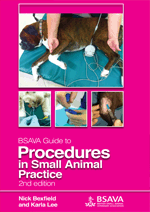
BSAVA Guide to Procedures in Small Animal Practice
Please note. The new 3rd edition of the BSAVA Guide to Procedures in Small Animal Practice is now available here.
This guide provides practical, step-by-step guidance on how to perform the diagnostic and therapeutic procedures commonly carried out in small animal veterinary practice. Routine clinical examination of the major body systems, and protocols for the management of selected emergencies, are also described. In addition to the actual technique, each procedure has information on indications and contraindications, equipment required, and potential complications, together with the editors’ own hints and tips.
-
-
-
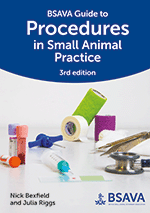
BSAVA Guide to Procedures in Small Animal Practice
This Guide combines high-quality imagery and illustrations, access to a suite of procedural videos and clear, comprehensive step-by-step techniques to provide an essential resource for diagnostic and therapeutic procedures in small animal practice. All procedures have been fully reviewed and updated, and four new procedures have been added, including cystostomy tube placement, endotracheal intubation, point-of-care ultrasound (POCUS) and wet-to-dry dressings. With alphabetised procedures, clear layout and references to further information, the third edition of the Guide is a valuable reference for vets, vet nurses, graduates and experienced clinicians alike.
-
-
-
BSAVA Guide to the Use of Veterinary Medicines
PLEASE NOTE A NEW 2ND EDITION HAS BEEN PUBLISHED AND IS AVAILABLE HERE.
The BSAVA Guide to the Use of Veterinary Medicines has been created by experts in medicine and dispensing regulations and is designed to help you navigate the minefield of issues, changes and regulations, and also to promote best practice. The Guide is freely available to the veterinary profession and is updated regularly.
Last updated: March 2022 (primarily prescribing cascade chapter 11); November 2020 (controlled drugs section key points); May 2020 (full review of guide)
Jonathan Cracknell’s darting manual is available to BSAVA members only.
The Veterinary Medicines Directorate supports this Guide to the Use of Veterinary Medicines written and published by the BSAVA.
Note: Before using this guide, readers are advised to read the disclaimer on the table of contents page of the full-guide PDF.
-
-
-
BSAVA Guide to the Use of Veterinary Medicines (2023)
The BSAVA Guide to the Use of Veterinary Medicines has been created by experts in medicine and dispensing regulations and is designed to help the whole veterinary team understand their legal, ethical and moral responsibilities in relation to veterinary medicines. This 2023 version of the Guide has been comprehensively updated and expanded, with new sections on dispensary management and reducing errors, marketing and advertising of veterinary medicines, and sustainable prescribing practices. A number of supporting videos and multiple-choice questions further enhance this edition.
The Guide is freely available to the veterinary profession and is one of the most-used resources in the BSAVA Library. It is reviewed regularly so please visit these pages for updated content.
Note: Before using this guide, readers are advised to read the disclaimer.
Updated November 2024 following review by the Veterinary Medicines Directorate (VMD).
-
-
-

BSAVA Lab Method Performance Verification Help Tool
Veterinary clinicians regularly use laboratory results to support decisions about their patients. Consequently, it is important to know whether the laboratory equipment they use to support diagnostic decision making is fit for that purpose. Many practices will perform some sort of quality control checks on their in-house analysers, however sometimes the ‘target range’ provided is too wide to detect clinically relevant analytical errors. Therefore, the BSAVA has developed guidelines and tools that will enable practices to optimise the quality control checks that they are already performing on their analysers. The BSAVA Lab Method Performance Verification Help Tool is accompanied by instructions for use and video guides.
-
-
-
BSAVA Manual of Avian Practice
A Foundation Manual Authored by veterinarians with experience in all aspects of avian care, this manual is an essential tool for those in general practice who do not often see birds. Subjects including anatomy and physiology, husbandry, behaviour, examination, and surgical techniques are covered in detail; common presentations are also dealt with in individual chapters. Includes video content.
-
-
-
BSAVA Manual of Backyard Poultry Medicine and Surgery
This manual provides practical and high quality information to help veterinarians provide the level of care to backyard birds that an increasingly wide client base expects and deserves. The manual covers chickens, turkeys, ducks, geese, guinea fowl, ornamental pheasants and peafowl.
-
-
-
BSAVA Manual of Canine and Feline Abdominal Imaging
The introductory section of this manual outlines the approach to abdominal imaging, with chapters dedicated to radiography and ultrasonography. The second section is devoted to imaging of the abdominal spaces and the common structures, including the vasculature and lymphatic system. The remainder of the manual is given over to the individual body systems.
-
-
-
BSAVA Manual of Canine and Feline Abdominal Surgery
The BSAVA Manual of Canine and Feline Abdominal Surgery covers everything from routine ovariohysterectomy to emergency drainage for acute peritonitis. Extensively revised and updated, this new edition provides a ready source of practical information. The manual features step by step operative techniques, notes on patient positioning and preparation, and new chapters on laparoscopic surgery and urinaryincontinence.
-
-
-
BSAVA Manual of Canine and Feline Advanced Veterinary Nursing
Written for qualified veterinary nurses, particularly those undertaking a diploma or degree in veterinary nursing, this manual provides practical information for those nursing at an advanced level. The contents includes Advanced nursing practice; Advanced medical nursing; Clinical nutrition; Physiotherapy and rehabilitation; Management of the critical care unit; Advanced fluid therapy; Advanced anaesthesia and analgesia; Advanced surgical nursing; Dentistry; Endoscopy; Advanced imaging; Clinical pathology in practice; Practice administration; Nursing clinics; and Behaviour.
-
-
-

BSAVA Manual of Canine and Feline Anaesthesia and Analgesia
Anaesthesia and analgesia is a constantly advancing field and the third edition has been extensively revised and updated to take account of the latest techniques and considerations. The structure, which has worked so well for the previous editions, has been retained and there are new chapters on pain assessment methods, anaesthesia for MRI and how to manage chronic pain. Full-colour illustrations, tables and charts allow readers to easily visualise techniques, ensuring that this manual will be a must-have for any practice.
-
-
-

BSAVA Manual of Canine and Feline Behavioural Medicine
The importance of animal behaviour and psychological wellbeing is increasingly being recognized in the veterinary profession. Safeguarding the pet-owner relationship and assisting owners in gaining a deeper understanding of their companion animals is an integral part of modern veterinary practice. This practical and user-friendly manual includes advice from an international cohort of authors. An appendix includes client handouts and questionnaires.
-
-
-

BSAVA Manual of Canine and Feline Cardiorespiratory Medicine
This manual reflects the huge advances in the field of cardiothoracic medicine that have taken place over the last ten years including clinical approach to the most common problems encountered in veterinary practice; diagnostic methods available, such as history, physical examination, imaging and laboratory testing; underlying pathophysiology of diseases associated with respiratory disorders, heart failure and arrhythmias; management of acute and chronic respiratory disorders, as well as management of heart failure and arrhythmias; up-to-date information on the diagnosis and management of disorders commonly encountered in practice, such as valvular heart disease, cardiomyopathies and canine and feline tracheobronchial disease.
-
-
-

BSAVA Manual of Canine and Feline Clinical Pathology
The new edition of this popular manual has been extensively updated to reflect advances in this field, while readers will also find new chapters on inherited and cardiac disease.
Clinical case studies have been retained, allowing readers to consider how they might approach common problems and see for themselves how test selection and interpretation are applied. Body systems are dealt with in their own discrete chapters, as are urinalysis, blood cells and proteins.
Full-colour photographs and illustrations can be found throughout, which will prove indispensable to clinical pathologists, clinicians and veterinary students keen to get grips with a rapidly expanding subject.
-
-
-
BSAVA Manual of Canine and Feline Dentistry and Oral Surgery
This fourth edition builds upon the previous editions to cover all aspects of veterinary dentistry and oral surgery, from examination and diagnosis to surgical techniques. New chapters cover ethics, perioperative considerations, and imaging and interpretation. Consideration is given to management of a range of conditions, including infectious conditions and developmental disorders.
-
-
-

BSAVA Manual of Canine and Feline Dermatology
PLEASE NOTE A NEW 4TH EDITION HAS BEEN PUBLISHED AND IS AVAILABLE IN THE LIBRARY AND IN PRINT
Dermatology constitutes a large percentage of the daily caseload in small animal practice and can represent a challenge for the busy practitioner as many different diseases have similar presenting signs. Thus, a solid understanding of how to approach a dermatological case logically and sequentially is essential for a successful outcome. The BSAVA Manual of Canine and Feline Dermatology begins by providing the reader with a grounding in examination and investigative techniques. The second section of the manual provides a unique problem-oriented approach to the common dermatological conditions encountered in practice, including erosions and ulcerations, focal and multifocal alopecia and pruritus. The final part of the manual covers the major skin diseases of dogs and cats caused by bacteria, yeasts, fungi and other parasites.
-
-
-

BSAVA Manual of Canine and Feline Dermatology
Skin and ear diseases represent common problems in general practice. As the response to treatment largely depends on the correct identification of the primary disease, a systematic step-by-step approach is critical. The purpose of the BSAVA Manual of Canine and Feline Dermatology is to be an easy-to-read resource focused on the clinically relevant aspects of dermatological diseases. In this new edition, the initial chapters review the basic structure and function of the skin and discuss a logical approach to history taking and the core investigative tests that can be performed. New to this edition is a separate chapter on skin cytology, which features many excellent images illustrating the cytology of common skin conditions that we hope will be useful to practitioners.
-